

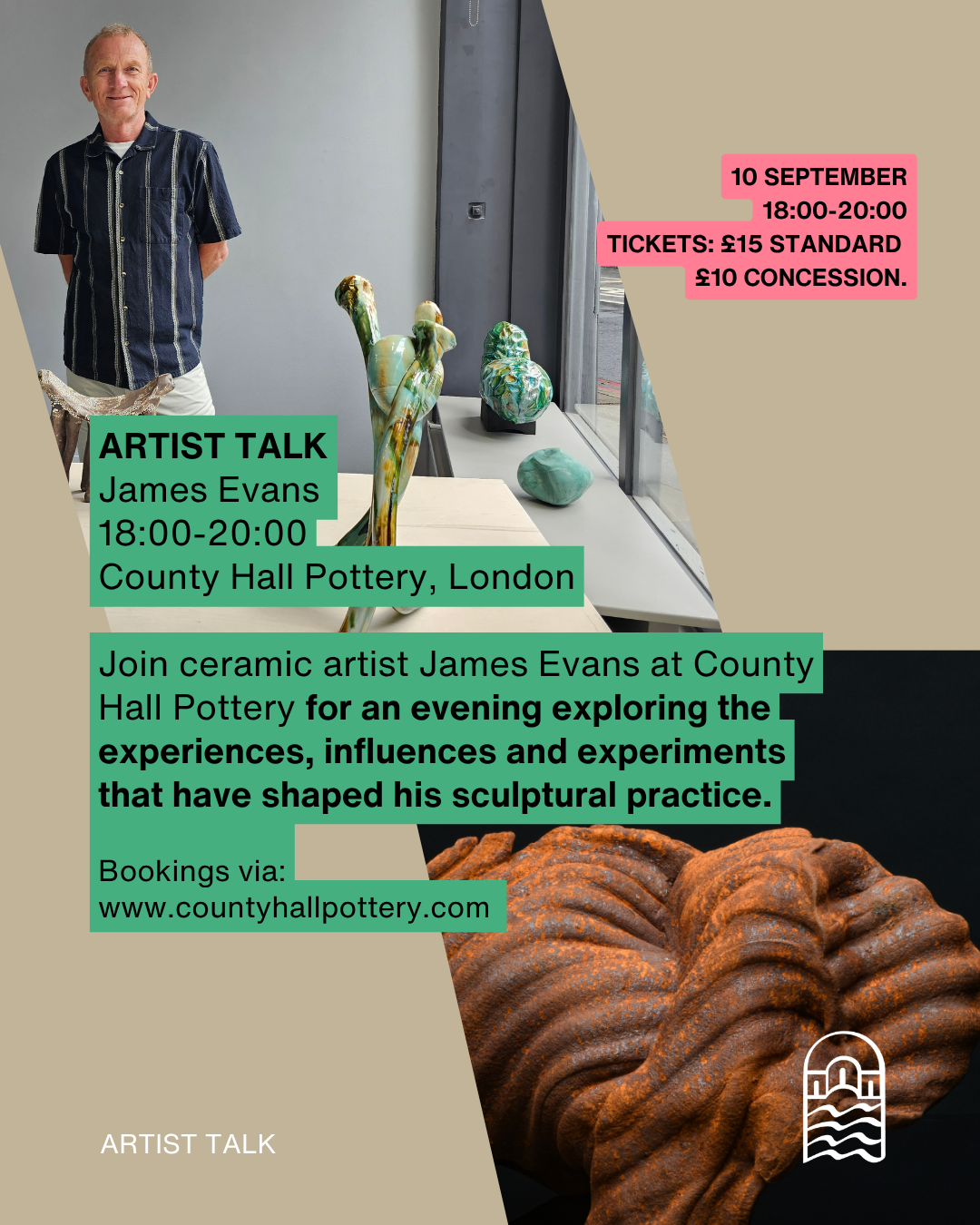
Join ceramic artist James Evans at County Hall Pottery for an evening exploring the experiences, influences and experiments that have shaped his sculptural practice.
Tracing his journey from art education in Suffolk and London to postgraduate study in the United States, James will discuss his transition from an early ambition to become a traditional potter towards an internationally exhibited practice centred on sculpture, architecture and the human form. The presentation offers a valuable opportunity to hear directly from the artist about the discoveries, accidents and changes of direction that have informed his work.
About the Talk
This illustrated lecture explores James Evans’s personal journey through ceramics, examining the education, mentors, cultural experiences and periods of experimentation that have shaped his artistic development.
James will reflect on studying in both the United Kingdom and the United States and consider how the different artistic philosophies, facilities and cultural settings he encountered broadened his understanding of ceramics. He will discuss his early ambition to become a traditional potter and the gradual development of a more sculptural approach to clay.
The talk will introduce key teachers and mentors who encouraged this transition, alongside an honest account of the creative process, from the first appearance of an idea to the technical and material decisions involved in bringing it into being.
A central theme will be the importance of chance and experimentation. James will consider how accidents, misjudgements and unexpected material outcomes have repeatedly opened new possibilities and redirected his practice.
The presentation will also explore the continuing relationship between the human form and architecture within his work. James will discuss the influence of London’s museum collections and the ways in which classical sculpture, architectural fragments and weathered surfaces have informed several bodies of work.
These include sculptural pieces inspired by fractured classical forms displayed on metal supports, as well as more intuitive, process-led slab constructions whose textured surfaces evoke eroded stone, reclaimed architectural details and the passage of time.
The talk will conclude with an opportunity for questions and discussion.